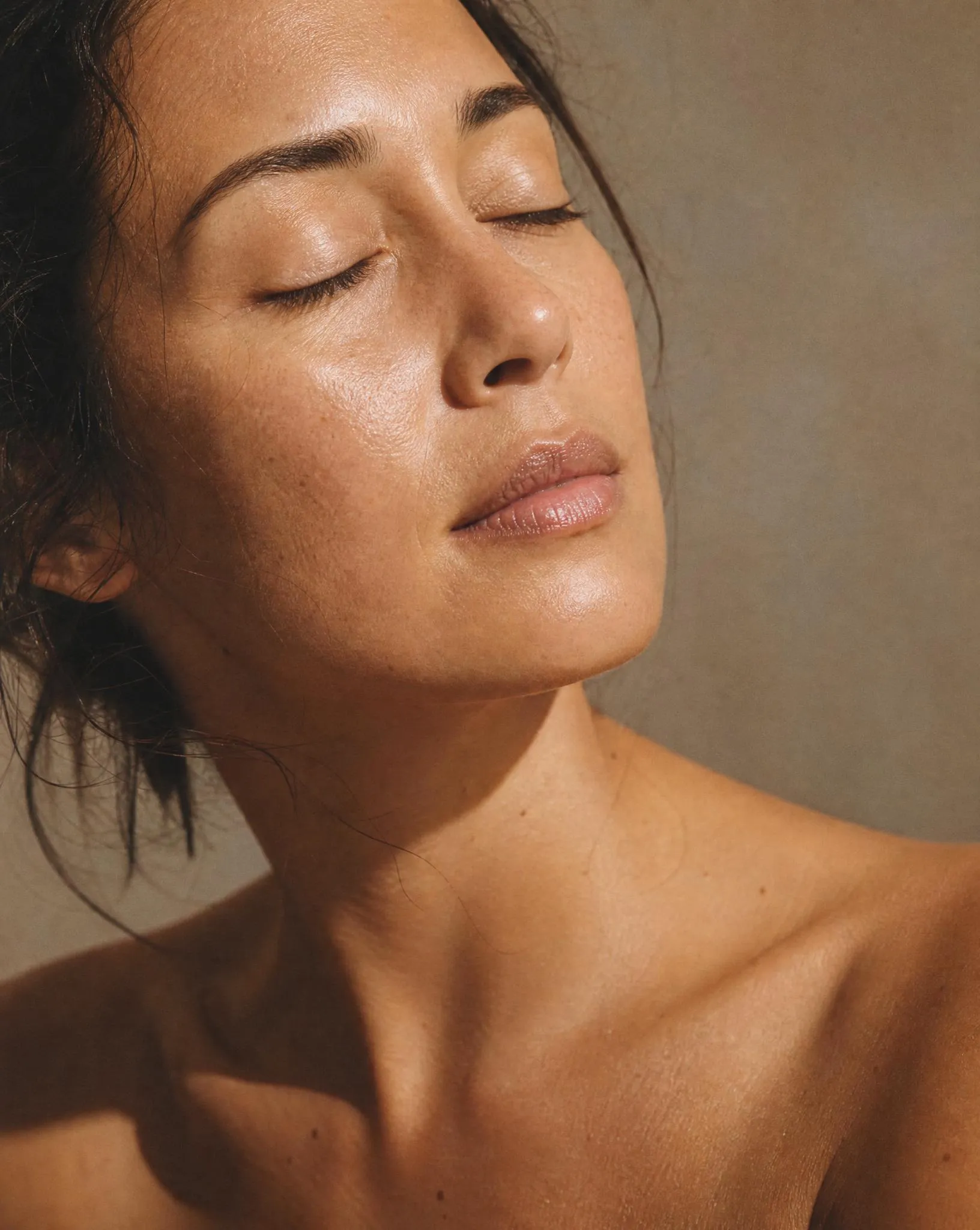
Your face is made of layers that work together. Skin, fat, muscle and bone each play a part. Each one also changes gently over a lifetime, at its own pace.
Getting to know these layers is a lovely way to understand your own face. It can also help you make calm, informed choices about caring for your skin.
There is no single reason a face changes. This guide walks through it, one layer at a time.
Your face in four layers
Picture your face as four layers. Skin sits on the outside. Fat sits beneath it. Muscle sits under the fat, and bone forms the base.
The skin is the layer you see and care for each day. It also sits over the other three, so it reflects how they all work together. That is why looking at the whole face tells a fuller story than looking at the skin alone.
The skin
Skin has a deeper layer called the dermis. The dermis holds two important proteins. Collagen gives skin its structure and firmness. Elastin lets skin stretch and move back into place.
Through life, the body makes these proteins at a slower pace. This happens gradually, over many years, as part of how every body lives and grows (Farage and colleagues, 2013).
Sunlight also plays a big part in how skin changes over time. The effects of ultraviolet (UV) light add up across the years. Everyday things matter too, including smoking, sleep and stress.
Australia has high UV levels, so daily sun care is worth building into your routine. Cancer Council Australia recommends sun protection whenever the UV index is 3 or above (Cancer Council Australia).
The fat compartments
This layer is the one that surprises people.
The fat in your face does not sit in one even sheet. It sits in separate pockets, called compartments. Thin walls of connective tissue divide them. Researchers mapped these compartments in a well known anatomy study (Rohrich and Pessa, 2007).
Some compartments sit deep, close to the bone. Others sit just under the skin. Each one behaves a little differently over the years. That is part of why every face changes in its own way.
It also explains why the whole face matters. Each compartment sits beside the others, so balance and proportion are looked at together.
The muscles
Your face has many small muscles. Several of them attach directly to the skin, which is unusual in the body. This is what makes such a rich range of expressions possible.
Each time you smile, laugh or frown, the skin above the muscle folds in the same places. Over the years, the lines that come with expression follow the pattern of how you move. Your expressions are a map of your own face in motion. No two maps are alike.
Habits play a part here too, such as squinting in bright light or clenching your jaw. A good pair of sunglasses is a simple, easy habit to add.
The bone
Bone can seem like the fixed part of the face. In fact, it is living tissue that renews itself slowly throughout life. Over the decades, facial bone changes shape gently too.
Bone is the frame for everything above it. The frame, the fat, the muscles and the skin all shape how a face looks, together.
Why every face changes at its own pace
Each layer varies from person to person. So does the pace at which it changes.
Your genes shape a lot of it, including your bone structure, your skin type and where your fat compartments sit. Sun exposure, smoking, sleep and changes in weight all play a part as well.
There is no set timeline. Comparing yourself with someone else of the same age tells you very little. Your face follows its own story.
Simple ways to care for your skin
Everyday care can support your skin at any age. A few simple habits go a long way:
- protect your skin with a broad spectrum sunscreen, a hat and sunglasses when the UV index is 3 or above
- keep your skin comfortable with a gentle cleanser and a moisturiser that suits you
- avoid smoking, and aim for regular, restful sleep
- look after your general health, and see your GP about any skin change that concerns you
If you would like to learn more about looking after your skin’s condition, read about skin hydration and quality.
How a consultation fits in
A consultation is a chance to understand your own face, layer by layer. We look at your skin and features with you, at rest and as you move. We explain what we see in plain words.
From there, we talk about what might suit you. That could be skin care advice, a review later on or nothing for now. We only suggest a treatment where it is appropriate for you, and we explain what it involves and what it costs. If waiting would suit you better, we will tell you.
Sources
- Farage MA, Miller KW, Elsner P, Maibach HI. Characteristics of the aging skin. Advances in Wound Care. 2013.
- Rohrich RJ, Pessa JE. The fat compartments of the face: anatomy and clinical implications for cosmetic surgery. Plastic and Reconstructive Surgery. 2007.
- Cancer Council Australia. UV Index.
Come and get to know your skin
We would love to meet you. Book a consultation at our clinic in Fairfield. We can talk about your skin, your goals and what would suit you.
Individual results vary from person to person. A consultation does not guarantee a particular outcome, and for some people the answer is that no treatment is appropriate. Our services are for adults aged 18 and over.